
Historians and economists who study ancient wealth typically place Nero's effective personal fortune in the range of $40 billion to $70 billion in modern US dollar equivalents, though some reconstructions push as high as $100 billion or more depending on how much of Rome's state treasury and imperial estates are attributed to him personally. These are rough analogies, not precise figures, and the honest answer is that no single verified number exists. What we can do is trace the logic historians use to arrive at these estimates and explain why any number you see online should be taken as an approximation at best.
Emperor Nero Net Worth: Best Estimates and Why No Exact Figure

Marcus Kellerman
29 May 2026
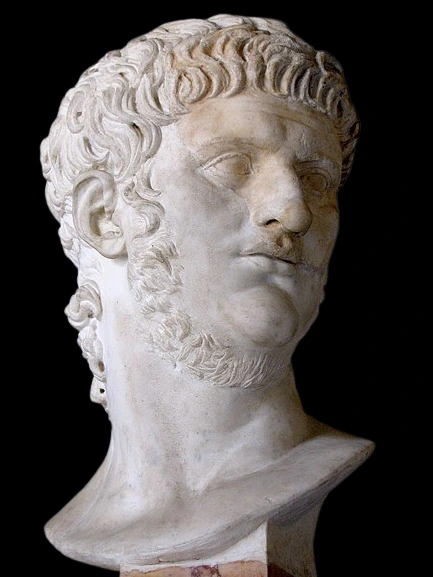
Nero's estimated net worth range
Most modern reconstructions place Nero's peak personal wealth, at the height of his reign around AD 60 to 64, somewhere between the equivalent of $40 billion and $70 billion in today's money. A handful of estimates go higher, sometimes north of $100 billion, when analysts fold in direct control of imperial lands, mines, grain supplies, and the Roman treasury itself. The wide range reflects genuine disagreement about where to draw the line between Nero's personal assets and the resources of the Roman state he controlled.
One anchor point researchers use: Suetonius records that Nero spent 800,000 sesterces per day hosting the Parthian king Tiridates and ultimately gifted him over a million sesterces. Scaled against Roman wages and purchasing power, that single event represents an almost incomprehensible outlay, which helps calibrate just how much wealth had to be flowing through imperial hands to sustain it. By AD 68, though, that wealth picture had changed dramatically.
What 'net worth' actually means for a Roman emperor (and why it's complicated)

Modern net worth is simple in concept: assets minus liabilities. You add up what someone owns, subtract what they owe, and you get a number. That framework does not translate cleanly to a first-century Roman emperor. Nero did not have a personal bank account separate from the Roman state. The emperor controlled the fiscus (the imperial treasury), vast estates across the Mediterranean, mines in Spain and Britain, grain supplies from Egypt, and tribute flowing in from dozens of provinces. Whether any of that counts as 'his' wealth in a modern sense is genuinely ambiguous.
Cassius Dio notes that Nero sometimes presented festival costs as coming from 'his private means' and at other times supplied money when the public treasury needed funds, essentially moving money between accounts that were both, in practice, under his control. Historians trying to isolate a 'personal' fortune face the same problem: the line between Nero's pocket and Rome's pocket was blurry by design. This is the single biggest reason why any net worth figure for a Roman emperor carries enormous uncertainty.
How historians calculate Nero's wealth (methods and sources)
There is no ancient balance sheet. What historians and economists do instead is reconstruct wealth from three main types of evidence: literary accounts, numismatic (coin) records, and archaeological data. The three dominant literary sources for Nero's finances are Tacitus, Suetonius, and Cassius Dio, all writing decades after Nero's death in AD 68. Princeton scholars have described these three as the essential corpus for any serious reconstruction of Nero's reign, and that includes financial reconstruction.
NBER working papers on ancient finance have used Tacitus-style data to reconstruct elite incomes and wages in Rome, including Nero-specific figures for guaranteed annual income and average annual gifts. These academic efforts treat documented spending events as data points and work backward to estimate what level of accumulated wealth could sustain them. It is educated inference, not a ledger audit.
- Literary sources (Tacitus, Suetonius, Cassius Dio): anecdotes about specific spending events, gifts, and confiscations converted into modern monetary equivalents
- Numismatic evidence: coin production volumes and metal content shifts, studied by institutions like the British Museum, help track fiscal stress across Nero's reign
- Archaeological data: the scale of construction projects like the Domus Aurea provides physical evidence of resource consumption
- Modern economic modeling: GDP-based scaling and purchasing-power conversions applied to documented sesterces figures
The practical limitation is that ancient sources were not accountants. Suetonius and Cassius Dio were writing partly to entertain and partly to moralize. Their spending figures were chosen to illustrate excess, not to provide an accurate audit trail. That does not make them useless, but it does mean you should treat any reconstructed figure with appropriate skepticism.
What drove Nero's wealth up (and then down)

Income sources and wealth accumulation
At his peak, Nero's effective wealth was fed by several massive streams. Imperial estates across the provinces generated agricultural income. Mines in Spain, Britain, and elsewhere produced gold and silver under direct imperial control. Provincial tributes and taxes funneled enormous sums through the imperial treasury. Political confiscations, a recurring feature of his reign, transferred private wealth directly to Nero. Suetonius describes how Nero leveraged the ruins of the Great Fire of AD 64 to extract 'contributions' from individuals and provinces, a mechanism that nearly bankrupted provinces and exhausted private resources according to ancient accounts.
The spending that drained it

The Domus Aurea, Nero's Golden House, is the most famous symbol of his expenditure. Built after the Great Fire of AD 64, it was a vast palace complex on the Oppian Hill in Rome, covering an area some historians estimate at around 100 to 300 acres. The construction cost alone would have been staggering. Beyond that, Cassius Dio describes Nero lavishing money on actors, horse races, gladiatorial games, and gifts to supporters, at a scale that he says 'exhausted the large sums of money that had accumulated in the treasury.' Nero reigned from AD 54 to 68, and by the later years of that reign the fiscal picture had shifted from accumulation to depletion.
How his downfall reshaped the wealth picture
Nero's death on 9 June AD 68, confirmed in British Museum historical records as a key numismatic and chronological anchor, marked an immediate reversal of his financial position. The British Museum also records Nero’s death on 9 June AD 68 and notes Galba’s succession, making this a useful anchor for modeling end-of-reign financial disruption and seizures Nero's death on 9 June AD 68.
The rebellion triggered by Vindex in AD 68 and the Senate's proclamation of Galba sealed Nero's fate and transferred control of imperial assets to the new regime. Nymphidius Sabinus had convinced the Praetorian Guard to abandon Nero by promising each soldier 30,000 sesterces, a donative that itself represented a massive fiscal shock, and one that Nero could no longer fund.
Galba's response to Nero's financial legacy was aggressive. blank" rel="noopener noreferrer">Suetonius records in the Life of Galba that Galba revoked Nero's grants and required recipients to repay them, allowing retention of only a tenth part of what they had received. Knights were assigned to help enforce the recoupments. Research in Archaeological and Anthropological Sciences has cited a roughly 90% recoupment claim in some analyses of the AD 68 to 69 period. This clawback effectively eliminated much of the distributed wealth Nero had used to build political loyalty. In terms of any net worth calculation, the end of Nero's reign represents a collapse, not a stable endpoint.
Why different sources give different numbers
If you search 'Emperor Nero net worth' across multiple sites, you will likely see figures that range wildly, from tens of billions to hundreds of billions of dollars. The variation comes from four main methodological choices that different estimators make differently.
| Variable | Lower estimate approach | Higher estimate approach |
|---|---|---|
| What counts as 'personal' wealth | Only demonstrably private assets and income | All imperial resources Nero controlled, including state treasury |
| Currency conversion method | Purchasing power of specific goods (grain, wages) | GDP-per-capita scaling across Roman and modern economies |
| Time period used | Late reign after expenditures (depleted) | Peak reign circa AD 60 to 64 (before major drain) |
| Treatment of confiscations | Excluded as one-time events | Included as recurring income stream |
When you encounter a number on another site, the practical question to ask is: what time period does it reference, and does it include state resources or just personal assets? A figure that bundles in full control of the Roman imperial treasury will always be far larger than one that tries to isolate only Nero's demonstrably private wealth. Neither approach is necessarily wrong, but they are answering different questions, so comparing them directly is misleading.
If you were searching for a different 'Emperor Nero'
It is worth flagging that 'Emperor Nero' is occasionally used as a stage name or persona in modern entertainment, and some readers searching this term may be looking for a contemporary artist, musician, or media personality rather than the Roman emperor. This article covers Nero Claudius Caesar Augustus Germanicus, the Roman emperor who reigned from AD 54 to AD 68.
If that is not who you meant, the best approach is to search the full name or add a clarifying term alongside 'net worth,' such as the person's genre, nationality, or profession. If you meant a modern athlete or celebrity, searching for their dovizioso net worth will give the right context.
If you are looking for a modern celebrity finance figure, you will want to switch to the correct profile for Dion Giannarelli net worth rather than using Nero’s historical estimates.
This kind of name confusion is common in net worth research. Similar disambiguation issues come up with other figures whose names overlap with historical titles or personas. If the result you find does not match the career timeline or industry you expect, that is usually a signal you are looking at the wrong person's profile.
How to verify or compare what you find
For a historical figure like Nero, there is no SEC filing or tax return to fall back on. The most reliable verification approach is to trace any estimate back to its primary source assumptions. Good reconstructions will tell you which ancient texts they drew on (Tacitus, Suetonius, or Cassius Dio are the standard trio), which conversion methodology they applied (purchasing power parity versus GDP scaling), and which period of Nero's reign they are modeling. If a figure appears without any of that context, treat it as entertainment rather than research.
Academic sources like NBER working papers on ancient finance are the most methodologically transparent, but they are also the most hedged. If you want the most defensible range to cite, something in the $40 billion to $70 billion band at peak reign, using purchasing-power conversion methods, reflects the academic mainstream without overclaiming. If you meant Silvio Dante from The Sopranos, his net worth is discussed separately since it comes from a completely different context than Nero's finances Silvio Dante net worth. Anything above $100 billion is typically using full state-resource inclusion or aggressive GDP scaling, which is a legitimate methodology but one that inflates the figure significantly.
FAQ
If there is no exact number, how can I tell whether an “emperor nero net worth” estimate is credible or just inflated?
Check whether the source states (1) which reign year or period it models (early reign, peak, or AD 64 to 68), (2) whether it treats imperial resources as “personal,” and (3) what conversion approach it uses (purchasing-power versus GDP scaling). Estimates that omit these details are usually not doing a transparent reconstruction.
Do the billion-dollar figures refer to Nero’s personal bank wealth, or does it include Rome’s money and resources?
Most high-end figures include some portion of state-controlled income streams such as the imperial treasury, mines, estates, and tax flows. If the estimate does not clearly exclude those, it is not a strict “personal assets minus liabilities” calculation in the modern sense.
Which period of Nero’s reign should an “emperor nero net worth” number correspond to, peak or late reign?
A figure is most often meant to reflect peak capacity around AD 60 to 64, when spending and wealth inflows could sustain extraordinary expenditures. Later years are commonly lower or collapse-like because the fiscal picture shifts from accumulation to depletion and the political break in AD 68 accelerates asset loss.
Why do some websites push figures above $100 billion for emperor nero net worth?
Those higher numbers typically result from including a larger share of imperial-state resources as if they were Nero’s own holdings, and sometimes from aggressive economic scaling that inflates “modern equivalent” values. It can be a valid modeling choice, but it changes the definition of what the number means.
How much can “festival spending” or gifts swing an estimate for Nero’s net worth?
Dramatic one-time outlays, like massive donatives or hosting expenses, can push reconstructed wealth requirements sharply upward because researchers back-calculate the level of accumulated resources needed to fund sustained spending. A single headline event can disproportionately affect the estimate, especially when the sources are not accounting records.
What is the biggest mistake people make when comparing emperor nero net worth numbers from different sites?
They compare dollar totals that answer different questions, like “personal fortune only” versus “control of state resources.” Without aligning definitions and the time period modeled, the comparison is misleading even if both numbers sound precise.
Do we know Nero’s net worth at the time of his death in AD 68, or only around certain peaks?
Most reconstructions are most informative around the middle of the reign, because the historical record is used to infer wealth capacity. The end of the reign is better described as a sudden financial and political reversal rather than a stable endpoint, because assets and control shifted quickly after the rebellion.
How should I interpret the Domus Aurea cost in emperor nero net worth calculations?
It matters because it’s a visible proxy for state-scale spending after the Great Fire, but construction and resource allocation can be modeled differently. Some estimates treat the whole project as a direct wealth draw, while others fold it into a broader fiscal flow, which can shift the final number.
If I see an “Emperor Nero” result that doesn’t match the Roman timeline, what should I do?
Disambiguate the person. “Emperor Nero” can be used as a modern stage name or persona, so verify the full name and career timeline before trusting any net worth figure. If the industry or dates do not match AD 54 to 68, it is almost certainly a different person.
What documents or evidence should a serious emperor nero net worth estimate be grounded in?
Look for transparent use of primary ancient narratives and clear translation into economic reconstructions, usually drawing from Tacitus, Suetonius, and Cassius Dio. If an estimate cannot explain its source basis and assumptions, treat it as entertainment rather than analysis.
Next Articles

Silvio Dante Net Worth: Character vs Real Person Estimate
Silvio Dante net worth, character vs real person. Data-based ranges, income sources, and how estimates are derived and v

Dion Giannarelli Net Worth: Estimate, Sources, and How to Verify
Dion Giannarelli net worth estimate explained with sources, identity checks, and steps to verify the latest figure today

Ava Frati Net Worth Estimate: Range, Income Sources, and How to Verify
Ava Frati net worth range estimate, income sources, and a checklist to verify net-worth claims reliably.